May 2, 2026 ·
About a month ago I wrote about LLM-enabled knowledge graphs and what differentiates information from knowledge: namely causation. This working definition comes from constructor theory in which physicist David Deutsch further distinguishes knowledge from explanatory knowledge, a sub-sub-set of information that enables construction. David asserts that while evolutionary processes also contain genetic knowledge, humans yield the universal power to explain the seen in terms of the unseen. Lots to chew there. I imagine it vaguely as naturally occuring power law distributions, in which the game is to parse haystacks of information for needles of knowledge that explain reality, enabling us to solve problems, construct concepts or objects, and write new programs among other things.
What about competing explanations?
It used to be easier to differentiate unserious explanations from serious ones by visiting libraries, attending universities, finding smart people to talk to and debate with, probably other methods known to veterans of the trade. But with the printing press, the typewriter, the word processor, the internet, and now the LLM, it's both that the size of the haystack has exponentially increased, and everyone and their mom out there claim to have found many worthy needles in it. Even aesthetic compasses scanning for pleasing looking fine arts as proxy for intelligence and intellectual-looking academic papers can now be constructed with AI. What now? How does one distinguish between two needles of the haystack both of which claim to explain reality?
One of the more obvious answers here is that if people can automate the creation of academic-looking intellect, one can also automate the reception of it. It starts to look like some kind of high-frequency-trading situation, where if one transacting party has a bot doing its bidding, so does the other, and increasingly likely it's simply algorithms trading against each other at micro timescales. Knowledge similarly is being automated at blazing fast speeds, and one can imagine bots emailing each other and taking actions, conducting commerce, going on dates, and whatever future one cannot imagine. I'm repeating a few Stephen Wolfram talking points here, and I thought his blog reflecting on the increasing number of amateur physics theories in his inbox was a hilarious example of what we can expect for every field in the near future. But even with automated distillation, when one is left with only a handful of competing theories, Karl Popper's idea of falsifiability acts as the final boss of this situation. Popper is a genius for this: an explanation can never be proved true, but it can be proved false; for which one must have a competing explanation to compare it with.
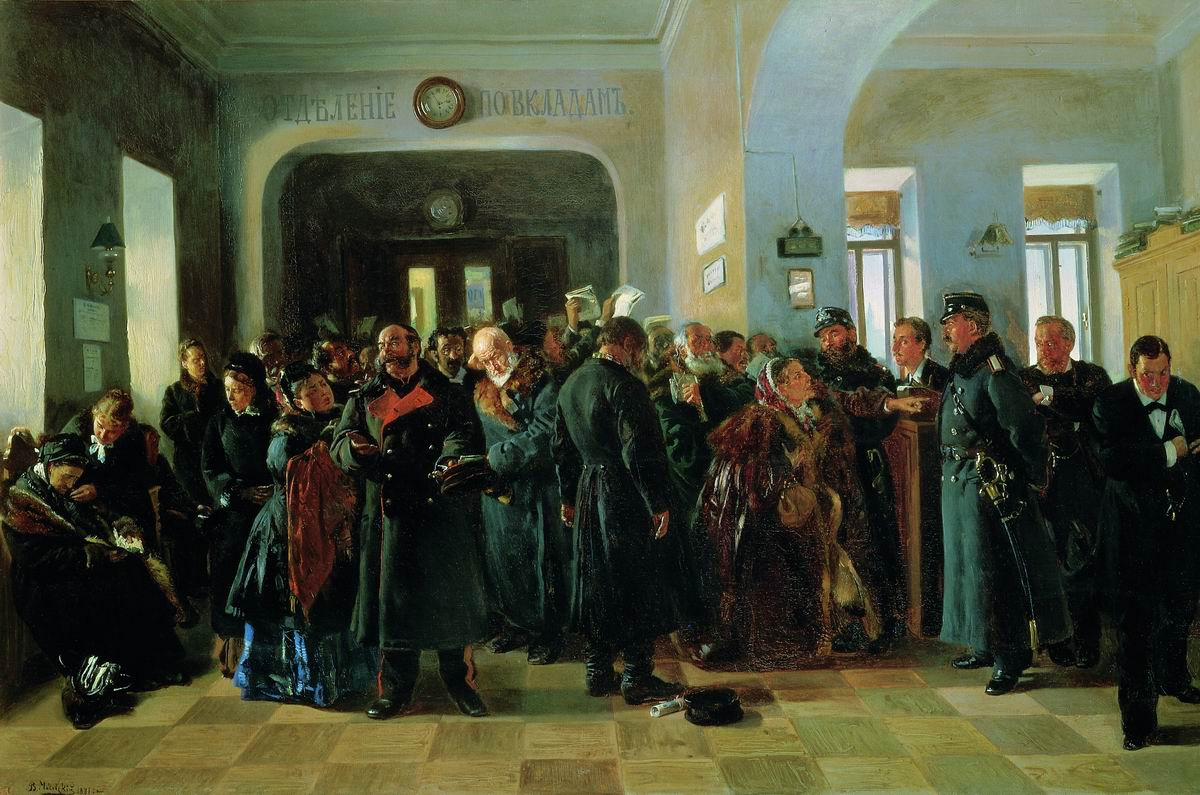
It may be a mistake to speculate too far out in the future and map what things may look like further out. But since the not-so-far-out future is more reliably mapped, a more sensible approach may be to be aggressive about building defensive technologies that enable one to continue being sane and at bay from information bankruptcy.
Bankrupt Bank by Vladimir Makovsky here.
comments section
~$1/comment: pay with card · pay with Ethereum